
Historically, the EB-2 NIW has stood out as a favored option for highly skilled individuals seeking permanent residency without employer sponsorship. Its core appeal lies in its focus on the applicant’s potential contribution to U.S. national interest. However, FY2024 data reveals that this once-straightforward pathway is becoming significantly more complex.
Since USCIS released its FY2024 data on EB-2 National Interest Waiver (NIW) adjudications, both industry professionals and applicants have felt a distinct shift: a comprehensive reshuffling of how “eligibility,” “national interest,” and “application strategy” are interpreted and rewarded is now underway.

What the Numbers Reveal
USCIS reports show a steep drop in approval rates—an unmistakable sign of tightening adjudication. For tens of thousands of advanced-degree professionals relying on NIW as a practical route, this isn’t just a change in trend—it’s a seismic shift in expectations.
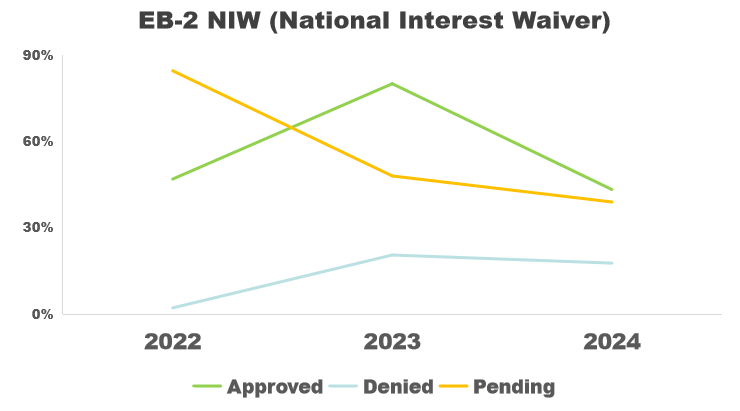
On one hand, as of FY 2024, the approval rate for EB-2 NIW cases has plummeted to 43.31%, while nearly 39% remain pending—a clear signal that both processing times and adjudication scrutiny have intensified.

These figures carry several implications:
- A drastic decline in overall approvals suggests that speculative or template-driven strategies are no longer viable.
- High pending case volume reflects longer processing times, increasing exposure to future policy changes.
- Rising denial rates don’t just cost time—they can disrupt long-term immigration planning.
On the other hand, EB-2 NIW approval rates consistently exceeded 90%(date of the all reviewed), establishing the category as a highly attractive and relatively predictable pathway between 2021 and 2022. This strong performance, combined with growing interest in U.S. immigration among global talent, drove steady growth in NIW application volume—particularly from STEM professionals, researchers, and engineers.
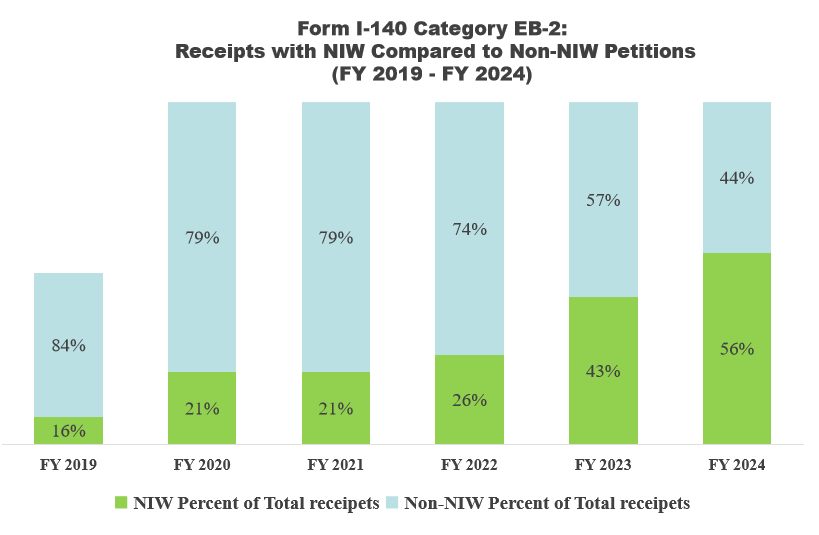
By 2024, however, the landscape had transformed dramatically. As the applicant numbers continued to climb, approval rates experienced a precipitous decline. Even for applicants who have already received decisions (excluding those still under review), the approval rate has fallen to approximately 70%. Based on current trends and increased scrutiny, projections suggest the ultimate approval rate will stabilize around 65%.
This shift reflects a fundamental recalibration rather than a temporary fluctuation. USCIS has implemented a substantially more rigorous interpretation of what qualifies as “national interest.” Key elements like “prospective national benefit” and “substantial merit” now demand far more compelling and precisely documented evidence than in previous years.
What’s Driving the Decline?
Several converging factors are contributing to this downward trend in NIW approvals:
First:Stricter Interpretation of Adjudication Criteria
The decline in approved rate may be a result of an influx of unqualified candidates, who attracted by its benefits, drawn to the NIW category. We’ve seen rejected applicants who seem only marginally qualified—like a freelance consultant doing occasional contract work or the owner of a small pool‑maintenance business.
At the same time, we have also seen that recent USCIS denials have included highly qualified candidates such as prominent medical professionals with around 50 academic citations, and AI, cloud engineers working in big tech companies, who were also denied because of ill‑preparation.
This comes as no surprise. Since early 2025, practitioners have already noticed a significantly stricter application of the three-pronged Matter of Dhanasar framework.
USCIS has increasingly emphasized the need to demonstrate:
- Substantial merit of the applicant’s work
- National importance of its impact
- Ability to advance the endeavor independently, without employer sponsorship
It’s no possible to conclude that even previously strong cases now risk denial if any of these three components are insufficiently prepared .
Second: A Redefinition of “National Interest”
USCIS has fundamentally recalibrated its interpretation of what constitutes “national interest” in response to evolving economic and security priorities. This shift affects all applicants, with varying degrees of impact:
For STEM Applicants: While STEM fields like artificial intelligence, quantum computing, advanced manufacturing, and biotechnology remain favored categories, approval is no longer automatic. STEM professionals must now provide explicit evidence demonstrating how their specific work:
- Addresses critical U.S. technological gaps
- Creates tangible economic advantages in competitive global markets
- Enhances national security or essential infrastructure resilience
- Produces quantifiable benefits beyond academic or theoretical value
Simply working in a STEM field is insufficient without clear documentation of specific contributions to strategic national priorities.
For Non-STEM Applicants: The hurdles have grown substantially more challenging, as reflected in the quadrupled denial number since 2023. Non-STEM professionals might either consider another path, or present extraordinary evidence showing how their work:
- Fills crucial gaps that cannot be addressed through conventional employment channels
- Delivers exceptional value that transcends industry-specific benefits
- Connects directly to broader national objectives like economic growth, public health, or educational advancement
- Demonstrates impact metrics comparable to those expected in prioritized STEM fields
The key takeaway is that USCIS now requires all applicants—regardless of field—to substantiate their “national interest” claims with concrete, measurable evidence rather than theoretical assertions. Generic statements about contributions to U.S. competitiveness or prosperity are no longer persuasive without supporting data, third-party validation, and clear alignment with articulated national priorities.
This new standard demands that applicants in any field develop sophisticated, evidence-based narratives that precisely map their unique contributions to specific U.S. interests with compelling, verifiable metrics.
Last: Growing Backlogs and Slower Processing
Heavy case backlogs are pushing USCIS to prioritize well-structured, high-quality submissions. Vague, generic, or overly academic materials are more likely to be delayed—or receive RFEs (Requests for Evidence), prolonging the adjudication timeline.
Final Thoughts and How to Stay Ahead of the Curve
For prospective EB-2 NIW applicants, 2025 represents both challenge and opportunity. While standards have unquestionably tightened, well-prepared applications aligned with current priorities continue to succeed. Here’s how to position yourself effectively:
1. Embrace Data-Driven Preparation
Generic templates and outdated approaches are now liability factors. Successful applications increasingly depend on:
- Quantifiable impact metrics specific to your field
- Comparative evidence positioning your achievements against industry standards
- Forward-looking projections demonstrating continued contribution potential
Rather than focusing solely on past accomplishments, develop a compelling narrative about your future impact on U.S. interests, supported by concrete evidence and expert validation.
2.Align with Current National Priorities
USCIS is showing clear preference for applications that demonstrate direct relevance to established national priorities:
- National security enhancement
- Economic competitiveness in strategic sectors
- Critical infrastructure resilience
- Public health advancement
- STEM education and workforce development
When framing your case, explicitly connect your work to these priorities with substantive evidence rather than superficial claims.
3. Build a Multi-Layered Evidence Portfolio
Successful applications now require diversified evidence beyond traditional academic citations:
- Implementation evidence showing practical application of your work
- Third-party validation from recognized authorities outside your immediate circle
- Media coverage demonstrating broader recognition of your contributions
- Commercial impact metrics quantifying economic or industry effects
- Policy influence documentation if your work has shaped regulations or standards
This layered approach creates resilience against increasingly rigorous review standards.
Spoiler:We’re to share that Nora, your 24/7 intelligent immigration assistant — launching soon.Powered by insights from tens of thousands of real USCIS cases, Nora identifies how the agency evaluates applicants with profiles similar to yours. And it delivers step-by-step, expert, and personalized guidance tailored to your unique background. Nora also keeps you up to date with real-time policy changes, ensuring you stay informed and prepared throughout the process.
Join the waitlist to secure limited-time free access: http://www.smartniw.com/nora-waitlist

