
The Problem That Kept You Up at Night
If you’re applying for some U.S. visa / green card like the National Interest Waiver (NIW), you know that familiar uncertainty: Am I good enough?
You might find yourself comparing your profile to others online: “This person got approved with 50 citations—but I only have 8. Does that mean I’m doomed?” Then you’ll discover someone else who got approved without publications but worked at a prestigious company, leaving you wondering which factors actually matter most.
Even immigration experts we’ve spoken with face similar challenges. After all, how can anyone be an expert in every field from biomedical engineering to cryptocurrency?
So we decided to build something better: an AI/ML model trained on tens of thousands of vetted immigration cases that estimates your profile strength (based on your curriculum vitae) and calculates your success probability accordingly. Our AI/ML model doesn’t know or care anything about sales—it only provides the best estimation and advice based on data. Our first version focuses on the National Interest Waiver (NIW), with more visa types coming soon.
In the spirit of transparency and being helpful with our immigrant community, we’ve written this article to explain how we built it.
Training Data
We spent months collecting data from over 15,000+ real cases sourced from public records, legal databases, and verified sources. Think of it as creating the world’s largest database of “what actually works” in visa applications.
We invested significant effort in data cleaning to ensure reliability. We removed entries with minimal applicant information, filtered out unreliable sources, and excluded outliers that were extremely far from the average case. This rigorous approach ensures our insights are based on solid, verified cases—not random internet stories.
With this robust dataset in hand, the next challenge was figuring out what actually matters. Not all factors are created equal, and raw numbers don’t tell the whole story.
The Features that Our AI/ML Model Relies On
Traditional approaches usually only discuss simple merits such as publications, citations, etc. but we knew that wasn’t enough, because the success in many visa petitions is shaped by a broader narrative and real-world impact, not just raw numbers like publications and citations. Our AI/ML model incorporates dozens of features including many nuanced ones beyond publications, citations, degrees etc. Those features help catch all perspectives of your professional career, and our AI/ML uses them to match similar cases, and figures out which factors matter or not, such as:
- Professional context (like working as post-doc, researcher, engineering, or product manager, …. )
- Industry-specific roles (such as product manager at a hedge fund, or a researcher in a biotech company …)
- Yeas of professional / industry experience
- Cross-disciplinary achievements
- And many others
How Accurate Is Our Model?
The crucial question: does this actually work in practice? We didn’t just want to build something that looked impressive on paper—we needed to prove it delivers real predictive value.
Our Testing Approach We used rigorous validation methods, training our model on 85% of our dataset while holding back 15% as an independent test set the model had never seen. This ensures our accuracy metrics reflect real-world performance, not just how well the model memorized training data.
For the testing dataset, we fed each profile summary to our AI/ML model and let it predict whether it represents a strong profile (approval) or weak profile (denial). The model outputs a confidence score between 0 and 1—if the score is ≥ 0.5, the model considers it a strong (approval) case; otherwise, it’s classified as weak (denial).
Performance Results Below is the performance breakdown on our testing dataset:
| Label | Precision | Recall | F1-Score |
|---|---|---|---|
| Denial | 0.98 | 0.97 | 0.98 |
| Approval | 0.79 | 0.84 | 0.81 |
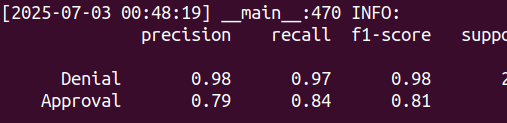
[Figure – The Screenshot from Our AI/ML Model’s Output]
If you’re not a data expert, you’re likely asking: what do these numbers mean? In plain English, our AI/ML model performs very well for denial cases (weak profile), with 97%+ accuracy.
For success cases (strong profile), the precision is 79% while recall is 84%. Here’s what this means in practical terms:
- When our model predicts success (strong profile), it’s correct 79% of the time (precision)
- For those who actually get approved, our model correctly identifies them 84% of the time (recall). In other words, if your profile is strong, our AI/ML model likely labels you correctly 84% of the time (but not 100%, so don’t feel discouraged if it doesn’t)
Why are there performance gaps? Why does the ML/AI model do better on the denial case? We had the same questions, so we conducted extensive analysis to figure them out.
A few reasons we identified: (1) Our collected data has many more denial cases than approval cases, so our model tends to perform better on denial cases; (2) in reality, a good profile never guarantees approval, as success depends on many factors beyond your CV—like case presentation, supporting documents, and legal strategy. Some visa decisions also involve subjective assessments (determining whether your work has “national importance” isn’t exactly a math problem). In Administrative Appeals Office (AAO) decisions, we see many good profiles that still get denied.
This all leads to lower precision in success cases predictions—after all, our model evaluates people’s backgrounds, not the final petition package or legal presentation.
Comprehensive Report For You
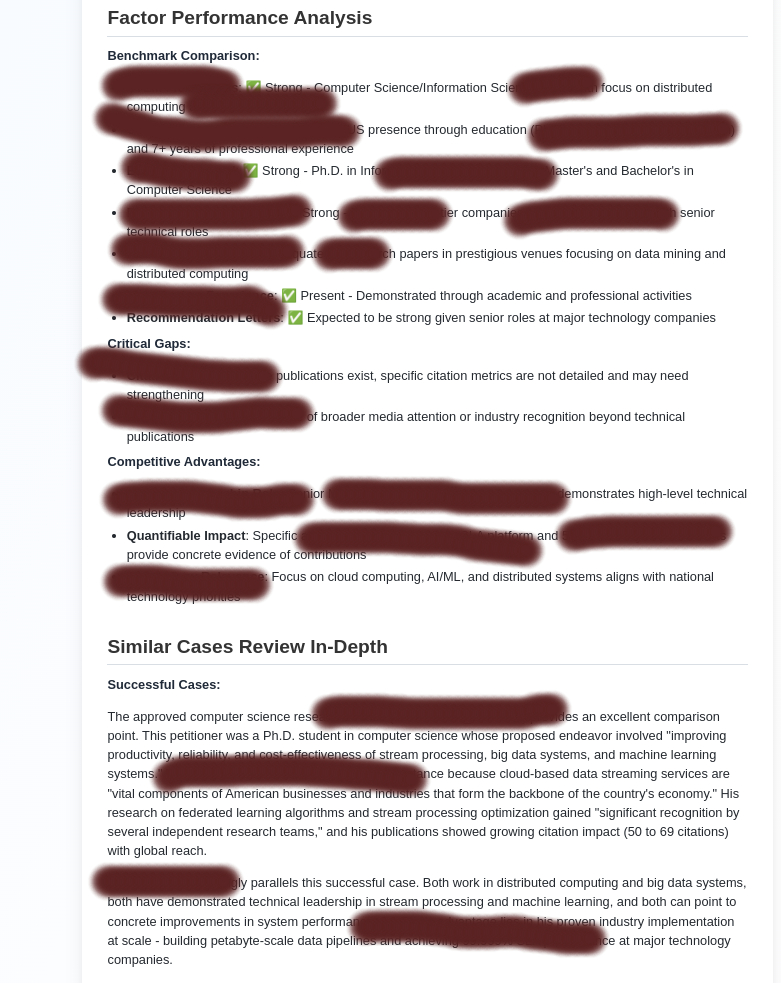
Our AI/ML model doesn’t just give you a number—it generates a comprehensive report to explain everything to you in detail, such as:
Profile Analysis: How your key factors compare with others in your field
Case References: In-depth analysis of what successful cases did right and what led to denials in similar profiles. We even provide links so you can verify these cases yourself.
Actionable Recommendations: Practical advice on what you can focus on to improve your chances and avoid the pitfalls that led to denials based on similar profiles.
After all, our AI has analyzed more cases and data than any individual consultant could review. We want it to give you the level of insight you can only expect from expensive consultation services (and unlike some “free consultations” that are really just to sell you $10,000+ services, our AI assessment has no such motive—just unbiased statistical analysis rather than subjective opinions).
Integration with Nora: Note that this feature has NOT been integrated into Nora’s capabilities yet. In other words, Nora can’t access this report and probability yet. We will make the integration soon.
Bottom Line and Disclaimers
- If the model flags your profile as weak, don’t feel discouraged. While its accuracy is very high for denial cases, it is definitely NOT 100% accurate.
- If the model flags your profile as strong, congratulations! But note that it doesn’t guarantee any visa/green card approval. As discussed above, even strong profiles can get denied for various reasons.
- Overall, the model achieves around 85% accuracy when combining both denial and approval cases. It gives you something that’s never existed before: an unbiased, data-driven way to understand where you stand based on real outcomes, not guesswork.
NOT Legal Advice: This tool is a statistical AI/ML model that evaluates your profile based on historical statistics—it doesn’t replace professional legal advice.
———-
Ready to see how your profile measures up against tens of thousands of real cases? We just beta launch: https://app.iterguide.com/evaluation .
Try it out and let us know what you think. You can reach out to us in channels such as:
- Email: admin@iterguide.com
- Join our WhatsApp Group: https://chat.whatsapp.com/FiblYV24ISW2YbefH2flkI ,
- Join our subreddit: https://www.reddit.com/r/O1EB1ANIW_DIY/ .
 IterGuide AI